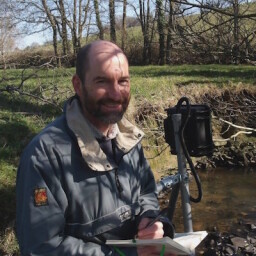
Environmental Scientist
It's been very warm recently in North Devon, with little rainfall. We've been looking at the impacts of this on some of our rivers ...
If you’ve been in Devon or anywhere in Europe for the past three months, you will know it’s been unusually warm. As a member of Biosphere staff with some responsibility for the Smart Biosphere, it’s probably not surprising I am interested in the data. One website I love for a number of reasons is: https://istheukhotrightnow.com/
The graphic below from this website shows the number of hot days we have had since May 24th.

What’s been happening in our rivers over the last few years and how will a warmer climate affect them? It’s a long and complicated story, told much better by others, for example Martyn Kelly in his Microscopes and Monsters blog: May 2024 – microscopesandmonsters (start at May 2024 to read about algae growth in rivers and climate).
I am just going to give a few simple snap shots from two water bodies that we monitor; the Croyde Stream and the Little Dart at Witheridge. Two quite different watercourses, Croyde is relatively short and steep coming off the edges of Exmoor, while the Little Dart is not as steep and rises at Rackenford moor, making its way through farmland for 20 miles to meet the Taw at Chulmleigh.
Our real time water quality sondes monitor a number of parameters, but I am going to focus on temperature which is directly related to the weather on the day and dissolved oxygen which is affected by temperature and a number of other factors.
Water temperature is key for healthy biological life in rivers with most UK species relying on temperatures between 12 – 18 oC. Above 20oC, most fish experience stress.
Dissolved oxygen measured in mg/L should range between 6.5 and 11 mg/L in a healthy river with 5 mg/L considered low and below 3 mg/L can cause death to aquatic life.
In the graphs below for the Little Dart at Witheridge we can see, in the early parts of June, water temperatures well below 20oC and oxygen at healthy levels. From June 26th we had some the hottest days this year and there is a clear relationship between water temperatures increasing above 20oC and dissolved oxygen (DO) reducing but still staying within acceptable levels. The daily fluctuations of temperature are expected, as are the DO fluctuations. Water plants and algae add oxygen to the water during daylight while oxygen is used by all life in the night time, due to respiration.
Witheridge June: how temperature varies alongside Dissolved Oxygen

During July, water temperatures were still peaking above 20oC for many days and this constant warmth, sunshine and the availability of phosphates encouraged algae growth, causing even bigger daily fluctuations in DO levels. There were a number of nights when DO is below 5 mg/L and sometimes as low as 2 mg/L. We know that this can be fatal for some river life.
Witheridge July: heat wave severely reduces DO

The data for the Croyde stream is similar but a little bit different. In June the daily DO fluctuations are less obvious and although the Croyde stream gets very warm on June 26th the DO levels don’t seem to be affected. This is because the stream is generally fast flowing and well oxygenated as water tumbles over rocks.
Croyde stream (Putsborough branch) June: DO looking good

Looking at the data for July, a more obvious daily pattern emerged and there were some concerning DO levels. There was a dramatic fall in dissolved oxygen at the end of July and I suspect this is because the site the sensor is located in was drying out and the pool may not be connected to the stream. Apart from the drying out of the stream, lower fluctuations of DO are mostly likely due to less algae growth, limited by the lack of phosphorus in the water.
Putsborough July: drop in water level impacts DO

What happens at very low flows in our water courses is demonstrated very well by another site on Huntacott Water (a tributary of the Little Dart). This stream has almost stopped flowing and is a chain of pools connected by very slow flowing water. In these conditions dissolved oxygen levels do not recover, as the water plants die and the lack of flow and severely reduced photosynthesis causes very poor biological conditions. Huntacott water is classified as poor for fish due to high sediment loads and these low summer oxygen levels won’t be helping. Note that DO is shown as % saturation here, but you can see the sustained low levels that will impact aquatic life.

This collection of data helps the Biosphere to identify priorities for our watercourses. At a Biosphere level, daily temperatures cannot be influenced, but streams and rivers can be shaded to reduce extremes in water temperatures. The Devon Woods project is assisting in this becoming a reality in some micro-catchments by helping to plant trees in riverbanks.
The water flow is very important, and the more water held on land in wetlands, ponds and sustainably managed soils will help stream flow continuously. Our DRIP and CRITTER projects have been working on this action.
If diffuse inputs of nutrients can be reduced rivers will not support excess algal growth and the dangerous fluctuations of DO that are associated with the eutrophication of water bodies and the possibility of an oxygen crash when water levels get too low. An example project seeking to tackle this issue is on the river Mole, where the Biosphere, Westcountry Rivers Trust, and farmers are working together to reduce sediment inputs. This collaborative approach is our best route to improving river health.